“It did feel like a race against time.”
That is how one worker at a major British supermarket chain described one frantic week this autumn.
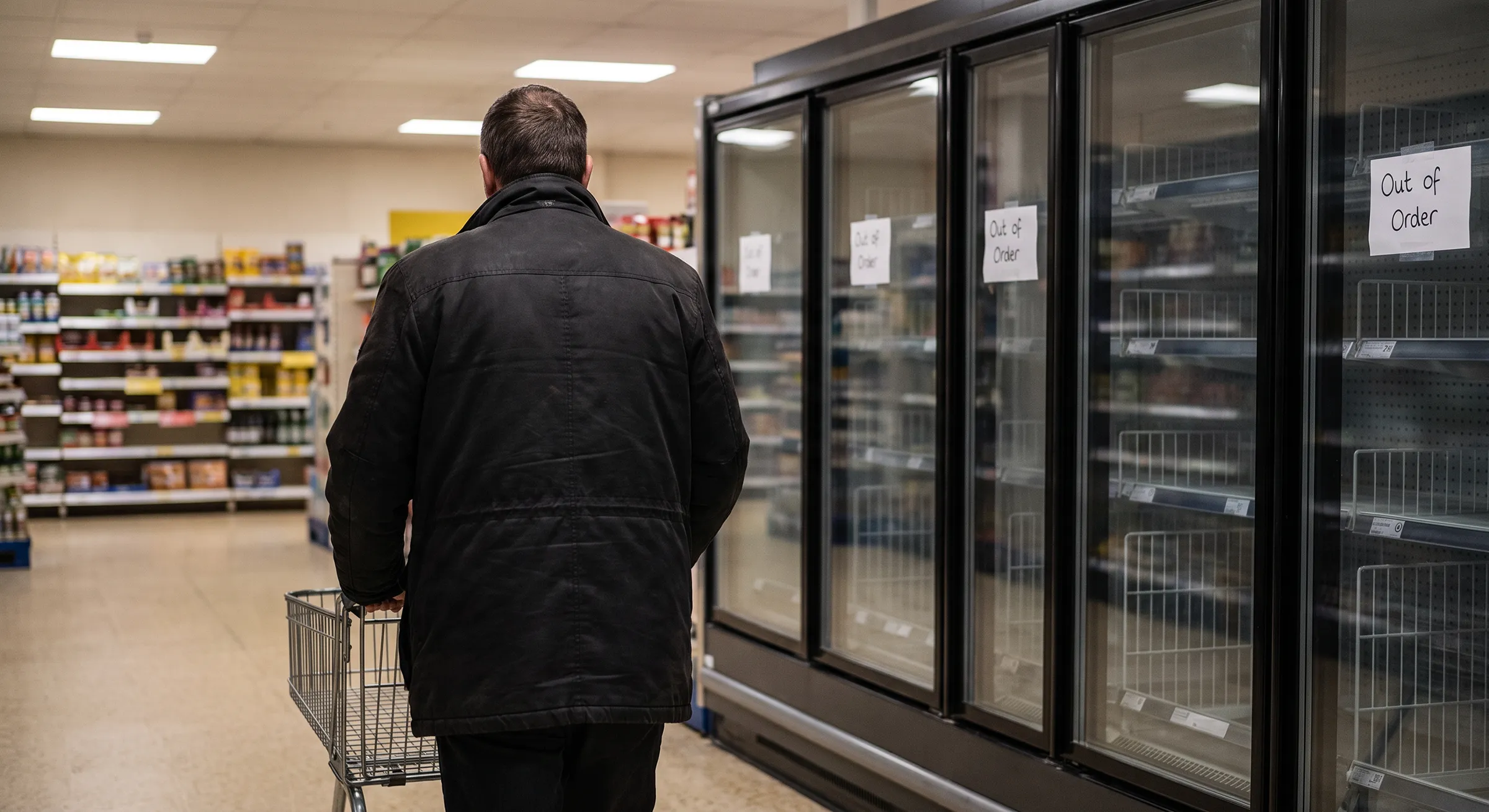
Every day, an IT team took hundreds of fridge controllers offline. They switched some off remotely. For others, someone pulled the cable out of the wall. Staff then checked freezer temperatures by hand, as they would have done in 1985.
Behind them sat warehouses holding millions of pounds’ worth of food. Ahead of them, they feared, lay a wave of attacks.
They had good reason to worry. In October, hackers took control of the freezers in hundreds of French supermarkets and turned up the heat. Stores threw away tonnes of food, and at least 15 fires broke out. France blamed a cyber unit linked to Iran’s Revolutionary Guard.
Researchers found a similar weakness in the controllers that most British stores rely on. It was a simple flaw. Like the controllers hacked in France, they were protected by weak passwords, and the hardware needed to probe them could be bought cheaply online. The National Cyber Security Centre quietly began calling the companies at risk.
Until then, nobody in those stores had thought of a freezer as a target.
The front line has moved. A unit linked to a foreign state can reach a supermarket’s freezers.
CTOs may not be interested in geopolitics. But geopolitics is increasingly interested in them. When trouble arrives, the board will not ask Tehran what went wrong. It will ask the person responsible for the systems.
A Prosecutor’s Inbox
A man sits down at his desk in The Hague and tries to open his email. The system won’t let him in. He tries again, with no luck. Then he discovers that his bank accounts back home in Britain are frozen too. He is one of the most senior lawyers in the world, with the power to seek arrest warrants against presidents and prime ministers. Yet he cannot get into his own inbox.
The man is Karim Khan, chief prosecutor of the International Criminal Court. The United States put him under sanctions after the court sought an arrest warrant for Israel’s prime minister.
Microsoft says it never cut off the court. Its president, Brad Smith, insists the company never stopped serving the ICC.
But Microsoft also described a process that excluded the sanctioned official from its services. So while the court kept its email, the prosecutor lost his. Microsoft did not make that decision. The US government did. Microsoft had to comply.
The ICC is now moving from Microsoft to openDesk, an open-source office suite backed by the German state. France plans to switch its civil servants’ computers away from Microsoft, and Germany’s chancellor is moving his own office off Microsoft 365.
Most companies will never face sanctions. But their email, files and systems sit with suppliers who must obey their own government.
Nobody outside that country gets a vote in what it does next.
Who Holds The Kill Switch?
“We’re not going to allow companies to build data centres in other countries.”
That’s what President Trump said at a news conference on Friday 20 November, after talks with Xi Jinping in Beijing.
He had praised AI and promised to support America’s data centres. He then suggested that companies building data centres abroad could face heavy penalties. He gave no details of how this would work and said he had not yet discussed it with his officials.
The idea may never become policy. But many SAP systems run in data centres owned by Amazon, Microsoft, or Google, and many of those buildings are in Europe. The companies that own them answer to the US government.
On 9 June, Anthropic launched Fable 5, its most advanced AI model. Three days later, the US government ordered it to block access by any foreign national, anywhere in the world. Anthropic could not check every user’s nationality, so it switched the model off for everyone. Across Europe, governments, companies, and research bodies, including NATO and the EU’s cyber agency, lost access overnight, with no warning and no date for its return. Access came back on 1 July.
For almost three weeks, a decision in Washington decided what Europe could use. The issue of sovereignty suddenly became a priority for European nations.
Choosing What To Depend On
“We just need to decide what we don’t want to be dependent on.”
That is how Anne Le Hénanff, France’s minister for AI and digital affairs, described Europe’s approach to the New York Times. She accepted that Europe cannot break free of American and Chinese technology. Instead, it is choosing which dependencies matter most.
The starting point is an uncomfortable number. In June, the European Commission said the EU relies on foreign suppliers for more than 80% of its digital products, services, infrastructure and intellectual property. Amazon, Google, and Microsoft dominate its cloud market.
So Brussels is planning a way out. A proposed law would bar non-European cloud providers from some sensitive government contracts. The EU also wants to at least triple its data centre capacity by 2030. SAP is among the companies expected to benefit.
Some public bodies have already switched. France is replacing Zoom with a French-built service, and the European Parliament is moving from Google search to Qwant, a French search engine. These are small steps, but deliberate ones.
“We just need to decide what we don’t want to be dependent on”
Britain has been slower. It has no formal sovereign cloud policy, and the government’s own guidance still allows departments to store data abroad. In January, 45 MPs from across the parties called for a UK digital sovereignty strategy, warning that public services depend on a handful of providers. A new national cloud strategy is due, but it has been delayed.
CTOs face the same choice, though nobody has written it into their job description. Their systems arrived one at a time, for good reasons, often under predecessors who have since left. The cloud comes from one supplier, the software from another, and the support desk may sit in a third country. Some of these dependencies are harmless. Others could stop the business within a day. The challenge is to know which is which.
People Sovereignty
Data sovereignty asks where data lives. A harder question is who can reach it.
At many companies, the answer includes people in other countries. Offshore support teams often log in to core systems every day and may hold admin rights. They can see customer records, supplier contracts and payroll. They also work under their own country’s laws and on its networks.
The data may be sovereign, but the access is not.
That matters when something goes wrong. A sanction, an internet shutdown, a border dispute or a government demand for access can cut a company off from the people who run its systems. A sovereignty plan that covers the data but not the access protects the data, not the business.
This is not an argument against offshore. It points to a gap in many sovereignty plans.
AI now offers a way to close that gap. It handles a growing share of the routine work that went offshore in the first place, so companies can bring some of it back in-house without the old cost. That gives the CFO a reason to care. Sovereignty no longer has to be pure cost. It can pay its own way, and contract renewals are the natural moment to look at it.
Three Tests
Each of the stories in this piece suggests a simple test that a CTO can run today.
First, the freezer test. Which devices in the business connect to the internet without IT knowing? In many companies, a controller on a warehouse wall was bought by facilities and installed by a contractor. It may still use its factory password. In October, devices like that cost French supermarkets tens of millions of euros. Most businesses have some, and few have counted them.
“Data may be sovereign, but the access is not”
Next, the inbox test. Who holds the keys to the core systems, and which government can tell them what to do? Karim Khan did not choose to lose his email. A decision in Washington reached him through his supplier. The same could happen to any company whose admin access sits in another country, if that country’s government changes course.
Finally, the podium test. What would happen if a government announced that a key supplier could no longer serve the business? The useful questions are what would stop first, how soon customers would notice, and who would keep things running. A company that can answer them is in a strong position. One that can’t has found its starting point.
Sovereignty does not mean owning everything or cutting every foreign tie. Europe has already accepted that this is impossible. It means knowing which systems the business cannot live without, who controls them, and what happens if that control is suddenly lost.
CTOs do not need to become experts in foreign policy. They just need to know their own systems. Then the next shock is a nuisance, not a crisis.