
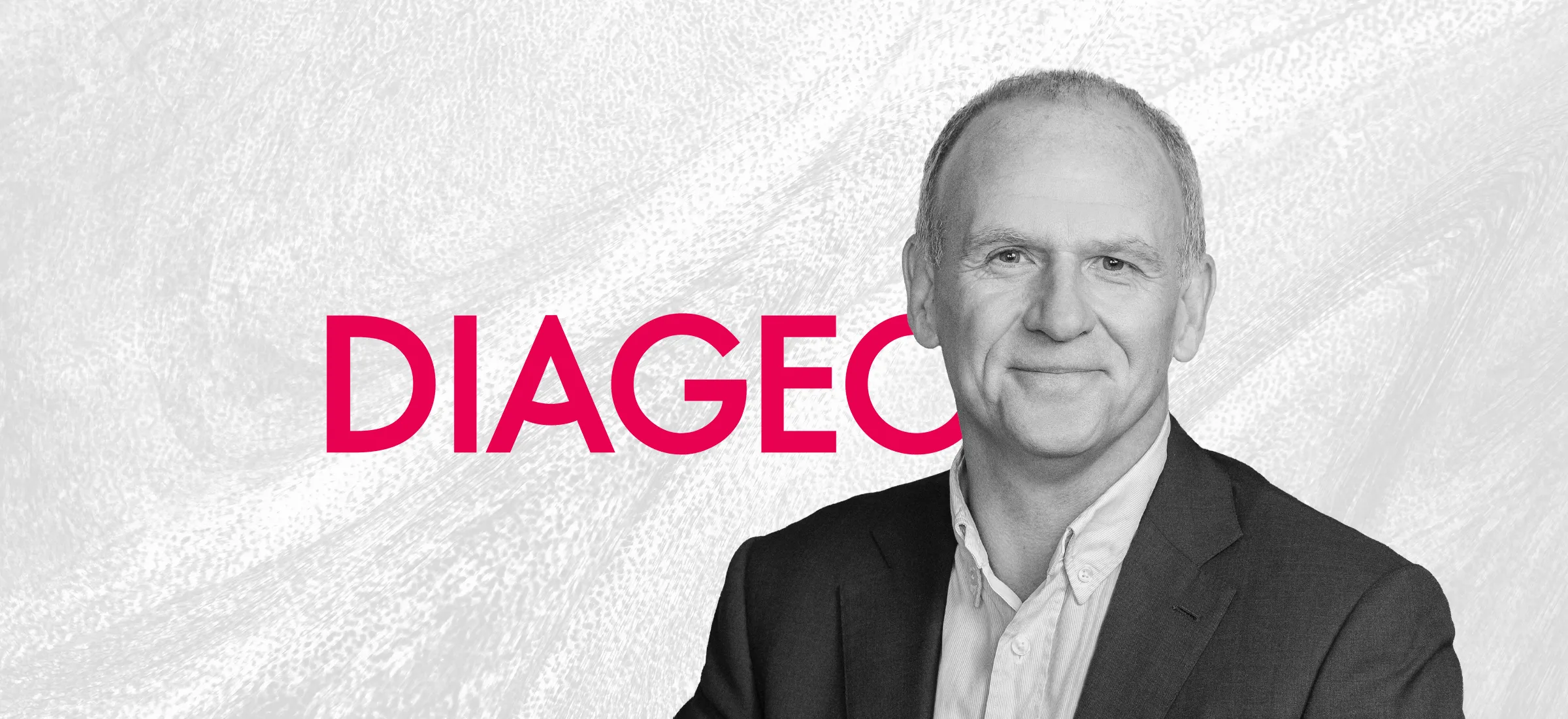
Diageo makes Guinness, Johnnie Walker and Smirnoff. On Thursday, August 6, its chief executive told investors he’s cutting $1 billion in costs to save it.
Sir Dave Lewis set out the plan at a capital markets day in London. $850 million of the savings will come from redesigning how Diageo operates. $150 million more from the supply chain. Restructuring to get there will cost $1.2 billion.
Diageo’s shares rose 7% on the news. This isn’t a cost-cutting exercise. It’s how Lewis is funding a seismic shift in how Diageo does business.
“The savings will allow us to invest in innovation selectively where we need to improve our competitiveness,” he told shareholders.
Organic sales fell 2% this year, to $19.6 billion. North America, Diageo’s biggest market, was down 8.4%, hit hardest in tequila. Lewis called it “category softness.”
The cause runs wider than one spirit. Only 54% of Americans now drink at all, the lowest figure in 90 years, and growth now depends on reaching the people barely buying anything.
Lewis’s answer is to put Johnnie Walker, Smirnoff and the rest of Diageo’s premium portfolio into ready-to-drink cans. They’re cheaper, lower commitment, sold wherever a cold drink is sold. Can Diageo deliver it fast enough, at scale? That’s what’s keeping Dave up at night.
Not Just Belt-Tightening
In January 2025, the then-US Surgeon General, Vivek Murthy, said no amount of alcohol is safe, warning that it raises the risk of at least seven types of cancer. That message has landed. Last year, only 54% of Americans said they drink at all, according to Gallup. Among 18- to 34-year-olds, it was 50%.
I.W.S.R., the research firm that tracks the drinks industry, recorded a 5% fall in wine, beer and spirits sales by volume in 2025. It expects an 18% drop over the next decade.
Weight-loss drugs are adding a less predictable push. Wegovy, Mounjaro and Ozempic -semaglutide and tirzepatide medications originally approved for weight loss – appear to blunt cravings for alcohol as well as food.
Early research from the University of South Carolina and the University of Colorado has found people on the drugs drink less, and drink less heavily, without trying to. One user told the BBC her tolerance had gone from two bottles of wine a night to “physically cannot drink another drop” after two glasses.
Since 2012, the average pub price of a pint of stout has risen 53%. The price of the same drink in a can, to take home, has risen 28% – nearly half as fast. Going out for a drink is getting expensive faster than buying one is.
None of this is directly Diageo’s fault, and none of it is going away. Lewis isn’t fighting these trends. He’s rebuilding Diageo around it.
Lower The Cost Of Saying Yes
Imagine someone standing in front of a supermarket fridge, not a shelf. They’re not thinking about whisky. They’re thinking about what to grab on the way to a barbecue, a picnic, a Tuesday night on the sofa. A bottle of Johnnie Walker is a £30 decision. A can is barely a decision at all. It’s already cold. It’s already mixed. It costs less than a round at the bar.
Reaching for a can instead of walking past the spirits aisle altogether is what Lewis is pointing a billion dollars of restructuring at. Diageo is redesigning its operating model, its supply chain, its cost base, around the second it takes someone to decide yes instead of nothing. Get enough of those moments to tip toward yes, at Diageo’s scale, and the effect compounds into billions in revenue. Miss them, and Johnnie Walker stays exactly what it is now: a drink most people never buy.
RTD is the vehicle for that moment. Lewis is also building room for low- and no-alcohol versions alongside it. It’s a different route to the same instinct: lower the cost of saying yes, in money or in alcohol, and more people will say it.
None of this is a new idea. It’s the oldest rule in consumer marketing. The biggest opportunity in any market was never loyal customers. It’s the much larger group who buy occasionally. Diageo doesn’t need Johnnie Walker drinkers to drink more Johnnie Walker. It needs the far bigger pool of people who currently buy none of it to start buying a little.
Not everyone’s convinced it will work fast enough. “Now comes the hard part,” said Chris Beauchamp, chief market analyst at IG, on the day of the announcement, “convincing and then showing investors that the turnaround plan is going to pay off.”
A Challenge Designed For SAP
A bottle of Johnnie Walker and a can of Johnnie Walker highball are not the same.
They are not the same product to make, package, or sell. Different production lines. Different can suppliers instead of glass and cork. Different case sizes, different pallet configurations, different barcodes. A bottle sits behind the bar for months. A can needs to turn over in a supermarket fridge in days. That means a completely different demand forecast, delivery schedule, and relationship with every retailer stocking it.
It is a challenge designed for SAP. It’s suited to the unglamorous machinery of production planning, inventory, logistics and demand sensing that decides whether “put whisky in a can” is a strategy or just a slide in a deck. Get it right and Diageo can read, in close to real time, which fridge in which country is running low on Smirnoff spritz, and restock it before the shelf goes empty. Get it wrong, and the can sits in a warehouse while a competitor’s product sells out next to it.
The temptation, at a company Diageo’s size, is to build something bespoke for RTD, bolt it onto the system, promise it’ll be faster. It rarely is. Customisation is what turns a nine-month rollout into a two-year one, and hands the CTO a maintenance headache for a decade after the consultants have left.
Standard SAP, properly configured, can already do everything Diageo’s RTD pivot needs. Different production runs, different packaging, all inside the same system.
Lewis Has Three Years
Diageo’s chief executive isn’t new to this kind of call. Sir Dave Lewis earned the nickname “Drastic Dave” turning around Tesco, and before that, cutting costs at Unilever. It’s a reputation built on making hard, fast decisions rather than commissioning another review. That’s the instinct behind this plan too.
Standard SAP, configured well, can run the production lines, the packaging, the retail listings and the forecasting that a shift like this demands, at the pace Diageo needs it.
What it can’t do is make the call. Whether Diageo moves fast enough, commits hard enough, and gets that can into enough fridges before the moment passes – that’s not a systems question.
That is down to Dave.
Image Credit: Diageo