Like other firms in the sector, the SaaS apocalypse has been tough on SAP.
SAP’s stock has lost close to half its value in a year. And yet Morningstar, a respected name in stock research, announced this month it thought the company was worth nearly double what it trades for today. Their fair value estimate: 265 euros a share. The stock has been sitting near 130 euros.
Which is it? One person close to SAP has proposed a standard for answering that. John Stenby, who works inside SAP’s own sales organization in Denmark, wrote last week that the company’s AI bet should be judged on what it ships between now and the end of the year, not on usage statistics, not on org chart reshuffles.
(It’s worth being clear that this is his suggested yardstick for customers and investors to use, not a deadline SAP itself has committed to in public.)
Yesterday’s release of SAP’s Q2 earnings is the first test against that standard, not the final word. How did SAP do?
SAP Still Growing, Faster Than Expected
“Current cloud backlog” tracks contracts customers have already signed for cloud software. It is work SAP hasn’t billed for yet, but knows is coming. It’s the clearest read on demand.
In the first quarter of this year, it grew 25%. Analysts expected the number to slow down in this quarter. But current cloud backlog grew 26%, matching or slightly beating the prior quarter’s pace.
It now stands at almost 23 billion euros. Part of that came from a newly acquired company called Reltio, which added a little less than one percentage point to the growth rate. But strip that out, and the underlying number still holds up far better than the market was expecting.
Cloud revenue, a more straightforward measure of subscription sales already being billed to customers, came in almost exactly where analysts expected. It’s up 22% to just over 6.28 billion euros. Total company revenue was up 9%, also landing right on target.
This is a data point in favour of the “SAP is oversold” camp. If backlog is holding up this well, the growth engine that’s supposed to justify Morningstar’s much higher price target is still running.
Profit Growth Slowed Down. SAP Says Why
Operating profit, the money left over after running the business, barely grew this quarter.
Using SAP’s preferred measure, which strips out one-time items, profit was up only 7% at exchange rates and 9% at constant currency. That’s a sharp slowdown from the 24% profit growth SAP posted one quarter earlier.
SAP gave four reasons for this. Revenue growth is slowing overall, in part due to the war in the Middle East. The prior quarter had unusually low stock-based pay costs, making Q1’s profit look artificially strong by comparison. SAP is spending more on research and development. And the company is absorbing extra costs from the recent acquisition of the data management company Reltio.
Profit margins slipped too, by small amounts across the board.
SAP trimmed its full-year profit outlook, from a range of 11.9 to 12.3 billion euros down to 11.8 to 12.2 billion euros. The company was specific about why. Two AI-related acquisitions it just completed, a data platform company called Dremio and an AI research firm called Prior Labs, are adding more than 100 million euros in costs that will drag on profit this year.
SAP’s AI push is already costing real money, showing up in real numbers, right now. Back to Stenby. What would he say about this?
A guidance cut, explained clearly rather than buried, funded out of SAP’s own margin rather than hidden behind adjustments, is exactly the kind of cost his standard predicted. By his own logic, this is evidence for the AI bet, not against it.
That’s the spending side settled, on his terms. The harder question is what customers are doing with the AI product that spending built.
Proof the AI Spending Pays Off
SAP named customers using its AI tools this quarter. SAP listed the airline booking group Amadeus, the BBC, Booking.com, the accounting firm PwC, and the mining company Vale as having chosen SAP’s AI and data products in the second quarter. Amadeus’s AI agent has already cleared “around 40,000 incorrect transactions,” said Klein, and PwC cut a 35-minute billing task to five minutes.
What would Stenby say about this? Probably: it’s a good start.
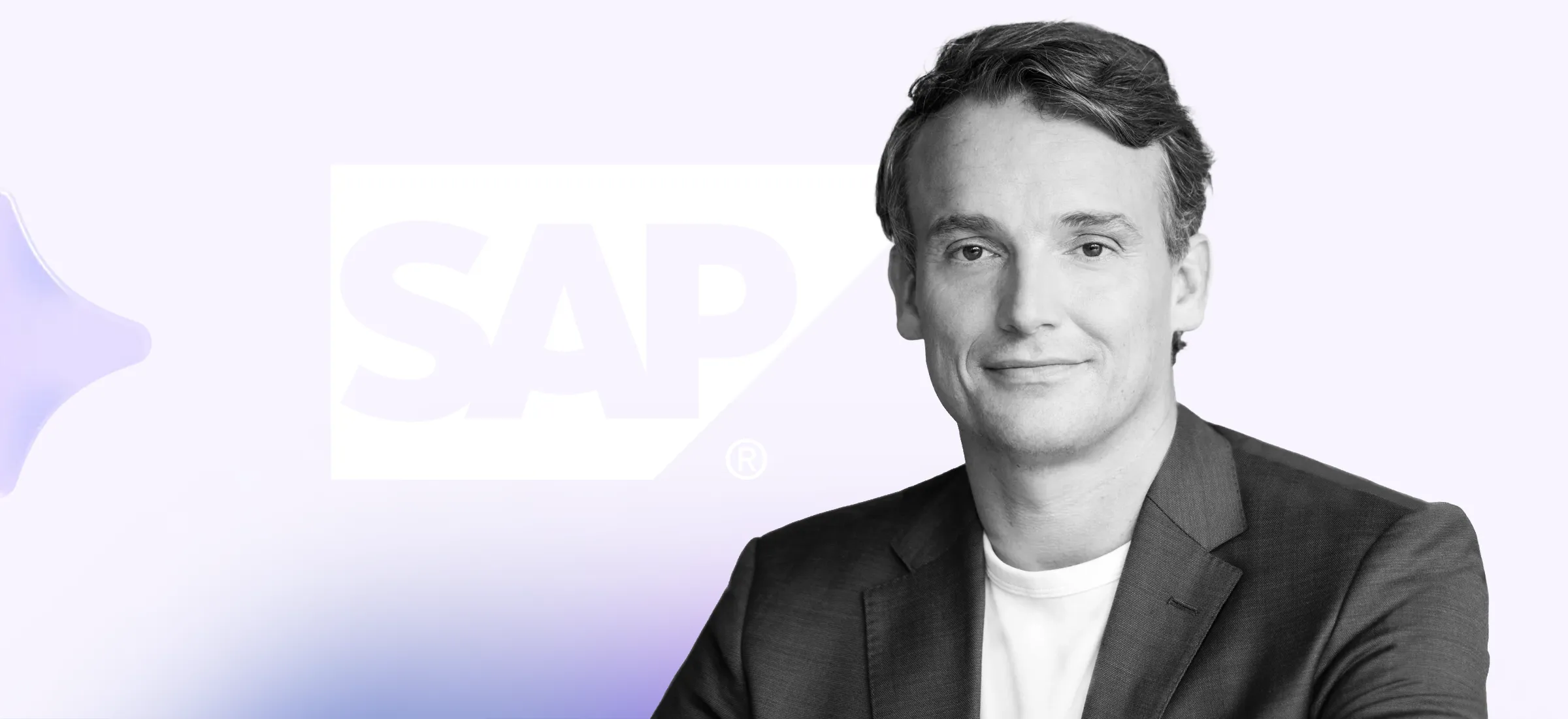
SAP CEO Christian Klein was asked directly on the earnings call when SAP expects to drive not just adoption, but monetization, of its AI solutions. Would it be by the end of this year, or further out?
Klein didn’t give a date. He said customer feedback had been “extraordinarily good,” but noted that many customers who built their own custom AI agents came back frustrated, missing the efficiency gains they expected, and struggling to govern agents across dozens of countries. He said that’s the gap SAP’s new platform is meant to close, and that despite macro volatility, SAP sees “a very positive pipeline” for the second half.
What’s the Downside Risk for SAP?
Salesforce CEO Marc Benioff called 2025 “the year of Agentforce,” his own company’s AI assistant. He promised it would change how businesses ran.
Only about a third of Salesforce’s customers have adopted the tool. One research firm found that just 23,000 of Salesforce’s 150,000 customers are actually using it day to day. Two separate Wall Street firms downgraded the stock on the same day this month. They both pointed to the same two problems. Customer data was too messy for AI to work with reliably. And the product was still stuck in small trial projects rather than real, company-wide use.
Salesforce has lost more than 200 billion dollars in stock market value since the AI promises started outrunning the AI results. Usage stats felt like proof, right up until Wall Street stopped believing them.
Stenby’s Standard
SAP’s shares moved higher in after-hours trading following the release. It’s a signal the market leaned toward reading the numbers as more reassuring than alarming.
Yesterday’s release is one data point against Stenby’s standard, not the final word. The backlog number is a genuine point in SAP’s favour. The profit slowdown and guidance cut are a genuine point of caution, one SAP has been honest enough to explain clearly rather than bury. Neither one, on its own, tells you whether the AI spending will look smart or wasteful by December.
Image courtesy of SAP